San Jose and the Bay Area sit at the center of California's accessory dwelling unit surge in 2026. New state laws have unlocked detached cottages, garage conversions, and rental units on lots where they were previously restricted. Homeowners are taking advantage. The part most people underestimate is the logistics of living in the main house while construction is underway.
That is where this guide comes in. Lunardi Moving Services has helped Bay Area families coordinate dozens of ADU storage projects, and the lessons are consistent. Plan storage early, pick the right container size, and use portable storage to avoid the trap of repeat trips to a remote self storage facility.
If you are building an ADU in San Jose in 2026, portable storage is almost always the better choice over traditional self storage. Lunardi Moving Services delivers a secure container straight to your driveway. You load it once at your own pace, and the container stays on site or moves to a Lunardi facility until construction wraps. One load, one unload, no daily trips across the Bay Area to a remote storage unit.
San Jose and the broader Bay Area are at the center of California's ADU surge. Statewide ADU permits jumped from roughly 6,000 in 2018 to nearly 16,000 in 2019, and Bay Area plus Southern California counties accounted for about 82 percent of all ADU permits issued in the state through 2021. The trend has only accelerated since.
Two laws that took effect on January 1, 2025 reshaped the landscape:
The result is a city like San Jose where backyard cottages, garage conversions, and detached units are no longer the exception. They are the path many homeowners take to add rental income, house aging parents, or build a real home office after returning to the office full time. The Bay Area's housing pressure, combined with the new state rules, makes 2026 one of the most active ADU years on record.
Most ADU planning focuses on design, permits, and contractor selection. The logistics of daily life during construction is the part homeowners underestimate.
An ADU project in San Jose typically runs 8 to 18 months from first sketch to final inspection. Design takes 1 to 3 months. Permitting takes 2 to 4 months. Construction itself runs 4 to 6 months for most builds, sometimes longer for detached units with utility hookups or for homes that need foundation work. Prefab ADUs can compress the total timeline to about 7 months but still require months of active construction on the property.
During construction the main house becomes a job site by extension. Dust travels. Tools take over the garage. Subcontractors need access to the side yard, the driveway, and sometimes the kitchen. Furniture, electronics, art, seasonal storage, and any belongings staged in the work zone need to leave the house safely. Self storage units off the freeway add hours of trips, expose belongings to repeated loading and unloading, and force homeowners to choose between paying for a moving truck twice or hauling everything themselves in multiple runs.
Portable storage solves the problem by bringing the container to the home and keeping it there as long as needed.
The two options sound similar on paper, but the experience differs dramatically once a project is underway.
Traditional self storage is a fixed warehouse facility. Renters drive to a remote unit, often along I-880 or US-101, every time they need to retrieve or add items. During a 6 month ADU build, that can mean 20 or more round trips with traffic and gas adding real cost. Self storage also requires two separate moving days, one at the start and one when construction ends, each with its own crew or truck rental.
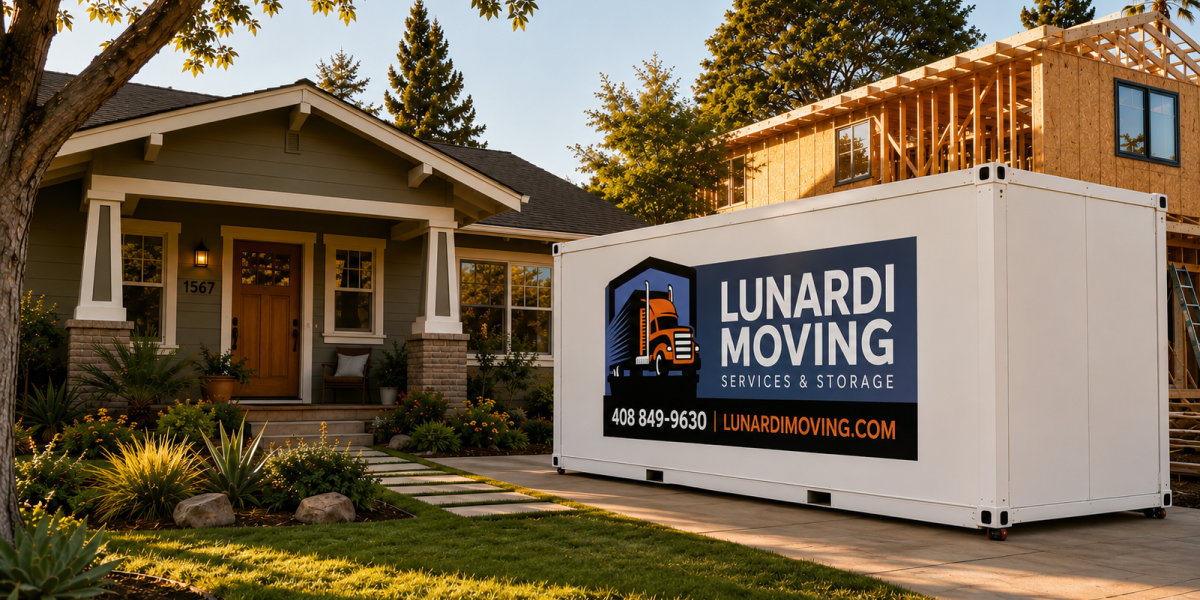
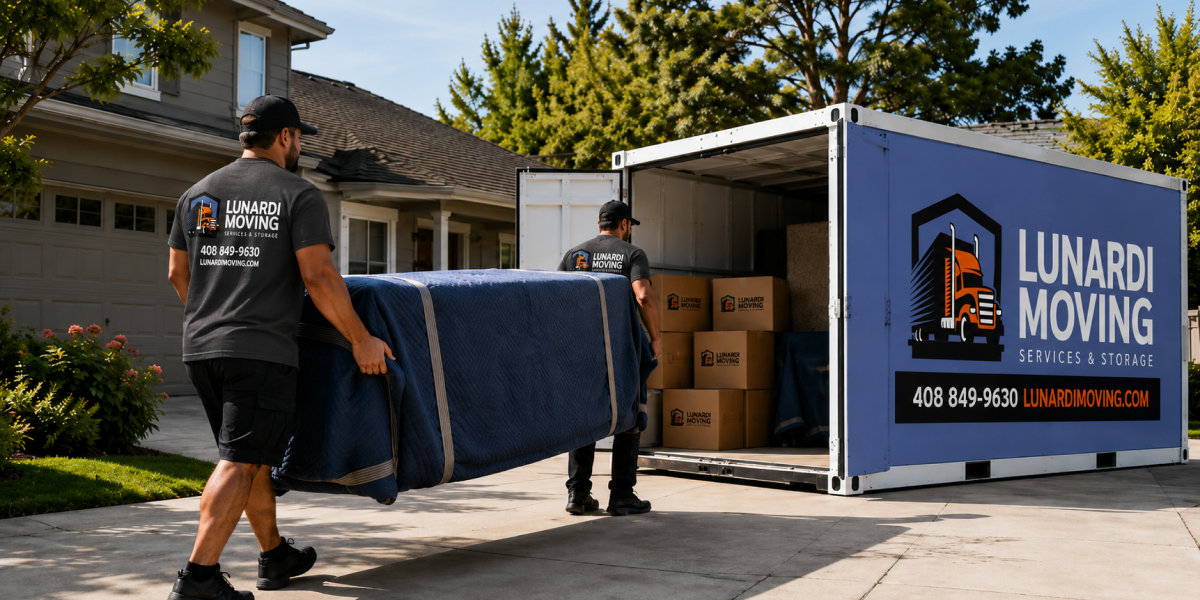
Portable storage flips the model. Lunardi Moving Services delivers a weather sealed container directly to the driveway or to a flat spot the homeowner approves. The container stays on site for the duration of the project, or it can be picked up and stored at the Lunardi facility for a flat fee. Loading happens once, over multiple days if needed. Unloading happens once, when construction is complete and the rooms are ready.
For a Bay Area ADU build the math almost always favors portable storage. Fewer trips, less risk of damage, lower total cost, and direct access on the property whenever the homeowner needs to grab seasonal items, paperwork, or a piece of furniture.
Lunardi has helped Bay Area families coordinate dozens of ADU storage projects. A typical timeline looks like this.
Month 1 to 3, design phase. No storage needed yet. Lunardi recommends a walkthrough at the end of the design phase to identify which rooms or zones will be impacted and to estimate the container size required.
Month 3 to 4, pre permit prep. The container arrives 2 to 4 weeks before contractors break ground. Homeowners load at their own pace, usually over a weekend or two. Lunardi can provide free packing materials and an optional packing crew for high value items.
Month 4 to 5, permitting approved, construction begins. The container stays on site if the driveway allows. If the side yard is tight or city rules limit street placement, the container moves to a Lunardi storage facility nearby. Access is available by appointment with 24 hour notice.
Month 5 to 12, active construction. Homeowners can swap items in and out as needed. Most clients only need access two or three times during this window for seasonal swaps or to grab tools.
Month 12 to 18, finish work and final inspection. As rooms come back online, items unload directly into the finished space. No second moving truck, no second move out fee.
This timeline shifts for prefab ADUs, which can compress to 7 months, and for projects with major foundation or utility work, which can push to 18 months or more.
The biggest mistake Lunardi sees on ADU projects is over storing. Homeowners pack everything into the container and then realize three months in that they need their air fryer, the holiday decorations, or the kids' bikes.
A practical rule for a Bay Area ADU build:
Lunardi's free pre move walkthrough helps homeowners decide what falls into each bucket and confirms the container size needed.
ADU costs vary widely in the Bay Area. A 500 square foot junior ADU runs $60,000 to $150,000. A standard detached ADU between 600 and 1,200 square feet runs $150,000 to $475,000 at $150 to $450 per square foot. Prefab options sit in the $100,000 to $300,000 range. San Jose permit fees alone hit roughly $17,265 for a new construction attached ADU between 751 and 1,200 square feet.
Storage is a small line item by comparison, but it adds up across a multi month build.
| Storage option | Typical monthly cost | 6 month total | 12 month total |
|---|---|---|---|
| 10x10 self storage unit | $180 to $260 | $1,080 to $1,560 | $2,160 to $3,120 |
| 10x20 self storage unit | $280 to $400 | $1,680 to $2,400 | $3,360 to $4,800 |
| Portable storage container (Lunardi) | Quoted per project | Often lower total with delivery and pickup included | Often lower total with one move in and one move out |
| Truck rental for self storage trips | $80 to $150 per trip | Adds up fast across the project | Adds up fast across the project |
Portable storage usually wins on total cost because it eliminates two truck rentals, fuel for repeat trips, and the labor of loading and unloading twice. Lunardi quotes are flat and transparent, with no hidden facility fees and no rate hikes during the project.
Building an ADU in 2026? Request a free portable storage quote from Lunardi Moving Services. We will measure the impacted rooms, recommend a container size, and lock in a price that lasts the entire build.
Every San Jose neighborhood has its own ADU pattern. Lunardi serves all of them and adapts the storage approach to each.
Older lots, mature trees, and tighter side yards. Most ADU builds in these areas are detached cottages or garage conversions. Portable storage usually parks on the driveway. When the driveway is narrow, Lunardi stores the container at the facility and rotates access for the homeowner.
Larger lots and longer driveways make this the easiest area for on site portable storage. Many families use the ADU to house aging parents, which means the storage period is short and often involves family heirlooms that benefit from professional packing.
Newer planned communities with HOA rules. Lunardi confirms HOA requirements before delivery and offers off site storage if street or driveway placement is restricted.
A mix of townhomes, condos, and single family lots. ADU projects are less common in dense townhome and condo settings, but garage conversion projects exist. Off site portable storage at the Lunardi facility is the standard solution here.
Lunardi serves the full Silicon Valley footprint. ADU activity in these cities has surged as homeowners use the new state rules to add rental units. Lunardi coordinates with city specific parking and right of way regulations to make sure on site portable storage is permitted before delivery.
Lunardi Moving Services is a family owned Bay Area company with deep roots in San Jose and over 50 years serving the region. The team knows the streets, the city parking rules, the HOA quirks, and the contractors. That local knowledge matters during a project that runs months and touches every room of the house.
For an ADU build Lunardi offers:
The Lunardi team has a 4.8 star rating across more than 168 verified reviews. Most ADU clients book Lunardi for both portable storage and the eventual furniture rearrangement once construction wraps, which keeps the entire project under one accountable team.
Ready to plan storage for your ADU build? Request a free quote and a Lunardi advisor will walk through the project with you.
Costs vary by container size and project length. A typical Bay Area ADU build needs one to two containers for 6 to 12 months. Lunardi provides flat project quotes that usually total less than equivalent self storage plus repeated truck rentals. Request a quote for an exact number for your home.
A typical ADU in San Jose takes 8 to 18 months from first design sketch to final inspection. Design runs 1 to 3 months. Permitting runs 2 to 4 months. Construction itself runs 4 to 6 months for most builds. Prefab ADUs can shorten the total timeline to about 7 months.
In most San Jose residential neighborhoods, yes. Lunardi confirms local rules and HOA restrictions before delivery. If the driveway or side yard cannot accommodate a container long term, Lunardi stores the unit at its Bay Area facility and provides scheduled access.
No. Pack only the rooms impacted by the build, plus fragile items in adjacent rooms exposed to dust or vibration. Keep daily essentials, current season clothing, and home office equipment accessible inside the house. Lunardi's pre move walkthrough helps homeowners decide what to store and what to keep.
An ADU is a fully independent living unit with its own kitchen, bathroom, and entrance. A Junior ADU is smaller, typically up to 500 square feet, often built within the existing home, and may share a bathroom with the main house. Both are governed by California state law and recent updates from SB 1211 and AB 2533.
Yes. AB 2533 expanded amnesty to cover unpermitted ADUs and Junior ADUs built before January 1, 2020. Cities and counties cannot impose impact fees on those units and must publish amnesty information. Contact the City of San Jose Planning Department for the local process.
Yes. Lunardi offers full service unload from the portable storage container into both the main home and the finished ADU. Many clients also use Lunardi to coordinate furniture for the ADU itself, including delivery from retailers, assembly, and placement.